The short answer: A line extension only makes sense if shoppers see a benefit your current line does not give them. Start from a consumer need, test it cheaply, count the full cost of another SKU, and launch only if it adds sales, holds margin, and fits the brand.
In our October post on whether to rebrand, refresh, or milk a maturing product, we said a refresh keeps the core positioning and builds relevance with new options and line extensions. Our example was shampoo for gray hair. The brand still stands for clean, healthy hair. It just meets a need the original line did not cover.
This post picks up that thread. Line extensions are the most common growth move in consumer products and one of the most commonly wasted. The difference between the two usually comes down to one question: does the shopper see a benefit, or only the brand team?
Line extension, new brand, or brand stretch
A line extension keeps your brand name and core promise and adds a new flavor, scent, size, or form for a need the current line misses. Same brand, same category, same reason to believe. A gray hair shampoo from a shampoo brand is a line extension.
A new brand is a separate name built for a different shopper or a different promise, usually because the existing brand would confuse or limit it. It costs the most to build because it starts with no awareness.
A brand stretch takes an existing name into a new category, like a shampoo brand launching a body wash or a candle brand launching a room spray. It borrows trust, but only as far as shoppers believe the brand’s expertise travels.
Our founder ran small Dial laundry brands at 29, and later worked on Pert Plus. Both taught the same lesson early: a familiar brand name buys you a trial, not a repeat. The product has to earn the second purchase on its own benefit.
Start from a consumer need, not a factory or a shelf slot
Good line extensions start with something shoppers want and cannot get from you today, not with what your plant can make or what a buyer has open. Those two triggers are where most weak extensions come from.
The factory version sounds like this: “We can run a new fragrance on the same line with no new tooling.” The retailer version sounds like this: “The buyer said she has room for two more items in the set.” Both are real opportunities. Neither tells you whether a shopper will pick the new item up, put it in the cart, and buy it again.
Start instead with a sentence a shopper would say. “My hair is going gray and my shampoo makes it look dull.” “I love this scent but I want it in my car, not just my living room.” If you cannot write the need in the shopper’s words, you do not have an insight yet. You have a capability.
When our founder sold the Claire Burke line to department stores such as Dillard’s and Kohl’s at Belae Brands, the items that worked were the ones a store associate could explain in one sentence to a customer standing at the counter. If the benefit took a paragraph, it rarely sold through. Home fragrance at Bath & Body Works reinforced the same point at much larger scale: the shopper decides in seconds, so the benefit has to be obvious. It also has to be real demand. The best path to success is meeting a need that already exists and that your competitors are not addressing. A product that mainly benefits you, by using spare capacity or filling a slot, is not a reason for a shopper to buy. It is never about you.
Simple, cheap ways to test whether shoppers see the benefit
You can test whether shoppers see the benefit with tools you already have before you spend a dollar on tooling or packaging. None of these needs a research agency.
- Reviews and support emails: read your last few hundred reviews and customer emails, yours and your retailers’. Look for repeated requests (“wish it came in unscented,” “too big for travel”). One request is a comment. The same request from many unrelated customers is a signal.
- Shopper interviews: talk to ten to fifteen people who buy your category, not your friends. Describe the benefit in one sentence and ask what they use today and what they would give up to switch. Listen for whether they restate the benefit in their own words.
- Retailer scan data: look at what is already selling in the category. If a competitor’s version of your idea is growing, the need is real. If the segment is flat, you are betting on creating demand.
- Search demand: check search tools and marketplace search bars for how shoppers phrase the need. Rising searches for the problem, not your brand, are a useful early read.
- Small pilots: sell a short run on your own site, in a few stores, or as a limited edition. Watch repeat purchase, not just first week sales.
For more on putting a benefit up against competitors, see our post on how to assess your differentiation.
The real cost of another SKU
Every new SKU carries costs that never show up on the launch slide, and most of them land after the item is on shelf. We see five again and again.
- SKU proliferation: more items mean more forecasts, more components, more minimum order quantities, and more chances to run out of the item that matters.
- Cannibalization: if the new item mostly takes sales from your existing items, you added cost and complexity without adding customers.
- Shelf space: retailers rarely give you more space for a new item. Often it replaces one of yours, or your facings get cut.
- Working capital and carrying cost: new packaging, inventory, and slow moving stock tie up cash that could fund the items that already earn.
- Buyer fatigue: a buyer who sees a steady stream of “new” items that do not move starts to discount your next pitch.
An illustrative example: suppose a new scent sells 1,000 units in its first quarter, but your core scent drops 700 units in the same stores. The real gain is 300 units, not 1,000, and those 300 units carry their own packaging, inventory, and slotting costs. (Illustrative numbers, not client data.) We covered how this quietly erodes a brand in Your Hero SKU Is Lying to You.
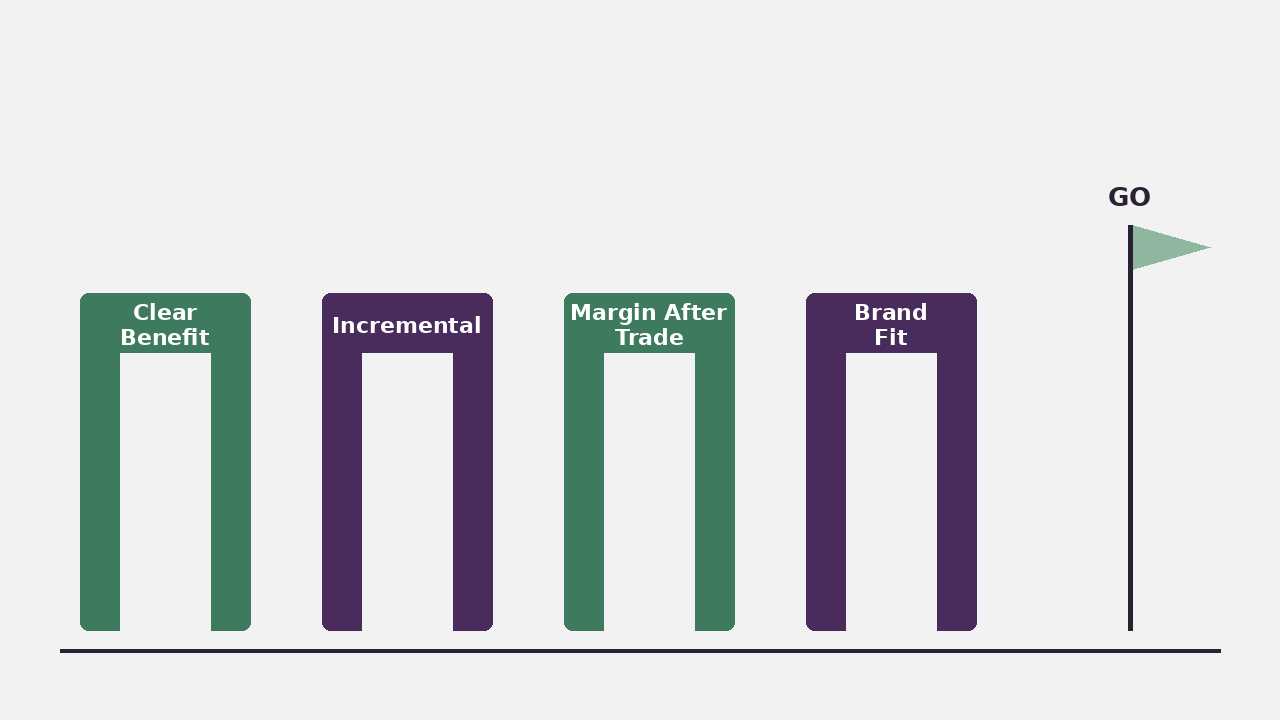
A four part go or no go test
Before you approve a line extension, it should pass all four of these questions. If it fails one, fix it or stop.
- Clear benefit: can a shopper say what the new item does for them in one sentence, in their words, and is it something your current line does not do?
- Incremental, not cannibalized: does your pilot or scan data show new buyers or new usage occasions, rather than the same buyers trading across your own items?
- Margin after trade spend: after slotting, promotions, and retailer margin, does the item still earn a contribution you would accept on your core line?
- Brand fit: does it reinforce what the brand already stands for, the way gray hair shampoo reinforces healthy hair, or does it ask shoppers to believe something new?
A yes on all four is a go. A yes on the first and fourth with weak numbers on the second and third usually means the idea is right but the size, price, or channel is wrong. A no on the first is a no, no matter how easy it is to make.
If you are deciding where a new item should sell first, our free Channel & Store-Type Planner helps you match the item to the right store type before you pitch it.
Next step
At Vantage Business Consulting, we help consumer brands decide which line extensions to launch, which to pilot, and which to skip, using shopper insight and P&L math rather than plant capacity or shelf pressure. If you have an extension on the table, bring us the idea and the numbers and we will pressure test it with you.